Friday, February 19, 2016

Throwback Thursday - LBJ

I am leaving in two days for Mason, TX to commence another Habitat For Humanity build. This will be my sixth project in the last year. Most builds are two weeks long. Mason will be three weeks long, but the one after that in Santa Fe, NM is only a week long.

During the last week I've been visiting friends (Frank, Kay, Paula, and Toya Sanders) that previously lived two doors west in Carbondale, IL. We haven't seen each other for 13 1/2 years, but the experience has been as if we only said goodbye last week when they migrated to Georgetown, TX.

We've been way too busy this week with food (too much), reminiscing, and assorted adventures. We've gone hiking along the North Fork of the San Gabriel River that flows through Austin, TX. And yesterday for Throwback Thursday (x 45 years) we visited the Lyndon Baines Johnson (LBJ) Presidential Library in Austin.

Today, we four all went flying for the first time without an airplane. More on that in my next blog entry.

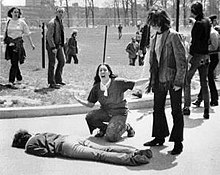
Jeffrey Miller shot by the Ohio National Guard
John Filo's Pulitzer Prize-winning photograph
My world view was enormously shaped by the events of the 1960s and 70s. I was in high school and college during the turbulent times of the Vietnam War, the domestic assassinations of three revered leaders (John and Bobby Kennedy plus Martin Luther King), the massacre of my peers at Kent State, civil rights protests, urban riots, the six day Israeli war, and the forging of the hoped for Great Society under the guidance of President Lyndon Baines Johnson (LBJ).

Bob Pauls
Photo by Sarah Maas (~ 1976)


Visiting the LBJ library brought back the vivid memories of my involvement in many social and political events on the period,  It was also the time of my first marriage with all the joys and struggles of a young couple trying to find their way in that tumultuous world.

The library is filled with sights and sounds of the period. Particularly poignant were recordings from the Oval Office wherein LBJ worked through his frustrations with trying the put an end to the fruitless war, eliminate poverty in America, end segregation, and protect the environment with the passage of  numerous laws. The two most noticeable pieces of environmental law were the Clean Air Act of 1963 and the Wilderness Act of 1964.

You will support this legislation, won't you Bob?
LBJ also used his power of persuasion to see passage of a twenty-two other Great Society laws. Below in bold are the laws that I personally am most proud to have seen passed by a far more compassionate and apparently, educated, Congress than what we have today.


  • 1963: Higher Education Facilities Act of 1963
  • 1963: Vocational Education Act of 1963
  • 1964: Civil Rights Act of 1964
  • 1964: Urban Mass Transportation Act of 1964
  • 1964: Nurse Training Act of 1964
  • 1964: Food Stamp Act of 1964
  • 1964: Economic Opportunity Act
  • 1964: Housing Act of 1964
  • 1965: Higher Education Act of 1965
  • 1965: Older Americans Act
  • 1965: Coinage Act of 1965
  • 1965: Social Security Act of 1965
  • 1965: Voting Rights Act
  • 1965: Immigration and Nationality Services Act of 1965
  • 1966: Animal Welfare Act of 1966
  • 1966: Freedom of Information Act (FOIA)
  • 1967: Age Discrimination in Employment Act
  • 1967: Public Broadcasting Act of 1967
  • 1968: Architectural Barriers Act of 1968
  • 1968: Bilingual Education Act
  • 1968: Civil Rights Act of 1968
  • 1968: Gun Control Act of 1968

  • The library also gives recognition of LBJ's wife, Lady Bird Johnson. Johnson died only two days after the swearing-in of his successor, President Richard Nixon, a man we learned to hate for his disastrous policies that prolonged the war in Vietnam.

    I highly recommend a visit the the presidential library on the University of Texas campus.

    Tuesday, February 9, 2016

    Search and Rescue Fundamentals


    National Association For Search and Rescue
    Over the last two weekends I participated with eleven other students in the 30 hour National Association of Search and Rescue (NASAR) SARTECH II Fundamentals class in Arkadelphia and Hope, Arkansas.

    The first weekend of training consisted of classroom instruction on wilderness survival, as well as, search and rescue organization, theory and practice.

    The second weekend was almost entirely in the field practicing theory and skills searching for a theoretical lost person in the thorny woods of central Arkansas. We were "called-out" to a deer hunting camp to look for lost female hunter that failed to return to camp. Looking for possible footprints we searched the base, performed a probability assessment of where the lost person might be and then formed "hasty search teams" to hunt for clues and signs. After finding footprints belonging to the person we tracked her trail step-by-step and found other clues down a dirt road on the way to a four way trail intersection. Since it was midnight when we arrived at the intersection and most of us were spent from a long day, we pitched camp to rest and resume the search at daybreak.

    After a wet, sub-freezing night we resumed the search following more clues suggesting that the possibly confused, disoriented, or ill person changed directions, doubled back on the trails. She was initially unresponsive to our auditory calls using her name. As we following her trail eventually getting closer to where she pulled off the trail for the night she responded to our signals. She was found just off the trail in the woods.

    After treatment for her deteriorated medical condition, she was carried out on a Stokes wire litter for transfer to a medical facility.

    That's Me Wearing The Rescue Pack Carrying My Portion of the Rescue Litter
    (Photo by Lora Frost)
    Rescues typically take about 72 hours to resolve themselves. What we learned from the exercise was how to apply resources on most land-based search and rescues, how to organize a search and assume specific roles as leaders, searchers, and record keepers. Then to round out our appreciation for the subject the instructors added knowledge components about incident command structures, environmental hazards and first aid, land navigation & orienteering; ropes, knots and & standardized rescue equipment; and legal obligations of search and rescue personnel.

    At the end of the sessions we took a 145 question subject matter and orienteering exam that, if passed, certified us as SARTECH III level SAR techs. When we return to Arkadelphia in a month's time to pass the field exam, we will gain certification as SARTECH II level techs. The field exam on March 13 consists of six sections:
    • Station #1: Land Navigation: Use of topographic maps and compass. Candidates complete a course over terrain commonly encountered in the operations area in a specified time frame, not to exceed 600 meters.
    • Station #2: Tracking: Candidates identify and mark a footprint track left by the evaluator and follow the track to its end.
    • Station #3: 24-hour Pack: Candidates should carry the basic survival and safety supplies for their environment and the items to complete the stations.
    • Station #4: Rope Skills: Candidates demonstrate the ability to tie four basic knots and a harness with supplied rope and webbing.
    • Station #5: Route Search: This station entails locating and labeling clues in a given area demonstrating the ability to detect 50% of the clues using a route search tactic.
    • Station #6: Area Search: This station entails locating and labeling clues in a given area demonstrating the ability to detect 50% of the clues using an area search tactic.
    Training beyond these fundamentals is highly encouraged. Specializations include man tracking, K-9, mountain/technical rope, whitewater, avalanche, and underwater search and recovery.  When I lived in southern Illinois I served briefly on the Williamson County Dive Recovery Team. I'll probably take further classes in the years ahead as the SAR subject is interesting to me on several levels.
    • Navigation is becoming a lost art. As a right of passage in the 1950-60s I was a Webloe, Cub Scout, Boy Scout, and Explorer Scout (now called Venturing). I earned a lot of merit badges in outdoor skills. Technical and natural orienteering were two of them and we needed those skills to take solo trips in the lakes and woods of northern Minnesota where I spent much of my youth. Navigation is seemingly no longer relevant to most outdoor experiences. Cell phones, satellite phones, GPS, emergency locator beacons, and modern camping technologies have substantially reduced the fear of perishing in the wilderness for all but the unprepared and unfit. 
    • Even if we have technological tools to survive, the average modern human has lost its connection to the full outdoor experience. Few people can navigate by the wind, stars, moon, sun, or tides. Even fewer know how to use their five senses to learn from and understand the stories nature has to tell. Deep ecology is little understood by voters, let alone politicians and lawmakers.
    • SAR is about saving lives or returning the remains of loved ones that perished in some unfortunate experience. Skills in providing shelter, providing nourishment and rendering medical care, plus transporting someone home to safety are the hallmarks of caring culture. 
    You too could become a member of a rural or urban search and rescue team. There are lots of duties that can be performed at headquarters if you are not able or inclined to go into the field on a physical search.

    Recommended Reading: 
    PLUS:
    Students:

    • Bob Pauls
    • Caleb Darnell
    • Justin Allen
    • Heather Schafstall
    • Holly Nichole Ballard
    • Jennifer Lefevre
    • Lora Frost
    • Nishant Mathure
    • Piper Scholfield
    • Shame Seaton
    • + 2 more
    Instructors:

    • Mikki Lee Hastings
    • Bill Rogers

    Take the Waters ... Please

    Hot Springs National Park, Arkansas

    Bathhouse Row, Hot Springs National Park

    The 19th century was the best of times and the worst of times.  On three divergent fronts. We had the idle rich that glorified luxurious travel We had pioneers braved the wilderness to forge a new nation, and we also had the uneducated/quack doctors and patients that sought and promoted quack cures for all sorts of maladies.

    Consider that...
    • Electricity was promoted as cure for numerous diseases.
    • Corn Flakes were marketed to cure masturbation.
    • Drinking or bathing in mineral water allegedly able to cure all sorts of ailments from alcoholism to arthritis, baldness, Bright’s disease, cancer, catarrh, chapped hands, constipation, diabetes, diarrhea, “female complaints,” flux, gout, hectic fever, high and low blood pressure, indigestion, insomnia, jake leg (a neurological malady caused by drinking moonshine whiskey containing tri-ortho-cresyl phosphate, an industrial chemical), malaria, milk leg, neuralgia, opium addiction, piles, pneumonia, rheumatism, ringworm, scurvy, sour stomach, St. Vitus’ dance, toothache, ulcers, and venereal diseases, plus various other unspecified skin, eye, stomach, bladder, liver, spleen and kidney problems."*
    Last week I took a side trip to the mother of all national park units, Hot Springs National Park in Arkansas. Besides my peculiar interest in questionable medical cures, I had been offered a volunteer park service job there this summer and wanted to check it out. 

    The original Hot Springs Reservation, the first designation of Hot Springs National Park, was set aside by Congress in 1832. Hot Springs National Park is thus the oldest of more than 400 units in the national park system. That's 40 years older than Yellowstone National Park. nd as such, it can rightly claim that it is America's Spa.

    In about 1870 westerners increasingly traveled to Hot Springs for the thermal baths and to drink the mineral water. Native Americans used it for centuries before that. It took another 100 years for the site to finally be placed on the National Register of Historic Places for its own protection. There's been a long history of conflicts among private landowners, entrepreneurs, and the federal government on what should be regulated to protect this natural resource. Like
    Malheur National Wildlife Refuge in the news over the last month, the federal government won the fight but works in partnership with local interests.

    Mineral water has historically been defined as "a natural water produced from a well or spring that naturally contains at least 250 parts per million total dissolved solids." Did you know that water spa aficionados distinguish about a dozen different types of mineral water? Thermal, Hypothermal, Mesothermal, Hyperthermal, Osmotic, Chemical, Oligomineral, Carbogaseous, Alkaline, Sodic, Saline / Chloro-Sodic, Sulfated, Sulfurous, and Ferruginous. **

    What intrigued me about Hot Spring's bathhouse row of seven historic spas was the segregated and regulated pseudo science of the operations. First of all these were initially white-only establishments primarily tended to by African-American attendants. The National Park Service rightly now exhibits the role of race in the operation of the facilities.

    Women's Treatment Room
    As for the pseudo-science aspects, you need to realize that many of the treatments offered at the spas then required a doctor's prescription to acquire. Not that there wasn't an economic motive to provide them to anyone that could pay the bill. Three of the treatments' apparati are captured in the adjacent photo I took.

    ~ Left, background) Multi-jet needle-like showers where dozens of water jets targeted specific parts of the body.

    ~ (Right, background) Mercuric sitz-baths where one sat in a short tub and allowed mercury-laden water to be absorbed through your mid-section.
    ~ (Foreground hoses) Intense, high pressurized enemas.

    (Not shown) Electrified soaking tubs.

    Enema Control Cabinet. Steam Cabinet on the Left.
    The more traditional regimen for the average patron was:
    1. Perhaps a workout in the private gym
    2. A hot shower
    3. A cold shower followed by a hot towel wrap
    4. A cool-down period
    5. Dressing in the latest styles in the ornate men's or women's locker room, and then 
    6. Socializing on the top floor in the men's smoking lounge or women's tea room.

    Men's Dressing Room
    Ceiling Above the Men's Dressing Room Scilpture
    All in all an interesting afternoon's visit and worthy of a visit and perhaps a modern spa treatment at one of the many commercial spas now still operating in Hot Springs, Arkansas. Should you choose to replicate "taking the waters" for your health I encourage you to skip the mercury baths and electrified baths.

    (Dry) Electrical Therapy Treatment Room

    See Also:  https://www.ncbi.nlm.nih.gov/pubmed/19230311
    Friday, February 5, 2016

    DeGray Eagles Et Cetera

    DeGray Lake Resort Logo with Blue Heron
    After spending a month layover at the Escapees RV Club headquarters camp in Livingston, TX my journeys have taken me to Arkadelphia and Hope Arkansas for my first Search and Rescue (SAR) training class.  I’ll be returning to Livingston after two weeks for a one week stay before traveling back west. However, I have to return to Arkadelphia in March to complete the field exam that completes my SARTECH II certification with the National Association For Search and Rescue. 

    I was only one of three RV campers staying midweek at DeGray Lake Resort State Park. It’s a very nice park this is with all the accoutrements of the modern state resort park: golf course, large marina, seasonal riding stable, widely spaced camp sites, and three rental yurts. It’s only by coincidence that I managed to pick the nicest of spots overlooking the 13,500 acre reservoir.


    When I awoke the first morning I inadvertently flushed from the tall pines surrounding my site a flock of previously unseen black vultures. To my surprise twenty-four vultures returned to one tree adjacent to the RV for the evening to catch the last warming rays of sunshine. Roosting but 50 yards away on a dead snag were two adult American Bald Eagles sharing the serene shoreline.


    Black Vulture
    Black Vulture
    My days at the lake were spent quietly hiking the local shoreline and purchasing the last of the SAR pack supplies needed for the training class. I’m a little surprised how few campers there were in the campground midweek. The weather was quite nice during the day and the temps only drop to the 40’s at night.

    The population soared on the weekend as it was the start of the park’s 37th annual “Eagles Et Cetera” celebration. No, this is not a fan club event for the rock band (I wish). Offered during the three day celebration were numerous eagle and owl watch tours, raptor rehab demonstrations, and a live falconry hunt.  I couldn't attend because they coincided with the training sessions, but I was able to see enough to know there will be plenty to see in this watershed.

    Midweek I drove north to Hot Springs, AR to possibly “take in the waters” before returning for the start of the training. More on that next time I post.

    Saturday, January 16, 2016

    2016 - A New Year of Adventure

    The Kachina Peaks from Mount Elden (by Tyler Finvold)

    January began with a respite from home building and and airline trip back to Des Moines for a medical checkup and diagnostics. It appears I'm healthy enough to keep on truckin down the road, so plans for the next ten months are now firming up nicely. I'll continue travelling in my RV throughout the West after a winter break in Texas and Arkansas.

    I had planned to take Toad Haul Manor to the even warmer Texas Gulf coast for a while, but a coveted summer workamping job opened up and I wanted to improve my skills to be better prepared for the position.

    I've accepted a summer volunteer position with the Coconino National Forest, Red Rock Ranger District in Flagstaff, Arizona with their fairly new Wilderness Preventative Search and Rescue Program (PSAR). Modeled after Yosemite and the Grand Canyon National Parks programs, the program seeks to reduce the number of injuries and deaths from hikers and campers being unprepared for the challenges of wilderness travel.  It's a collaboration with the Coconino County Search and Rescue, Friends Of The Forest Sedona, and University of Arizona. In the last three years an average of 80 search and rescues were needed, 24 on average requiring rescuing injured parties.

    In addition to the technical, educational, and preventative aspects of search and rescue, the position will assist eight+ other RV-based volunteers with other Coconino National Forest projects such as trail building, facility maintenance, trail patrolling, trail signage, natural/cultural interpretation and environmental education. We'll be staying in our own specialized little mountain community at Camp Elden in the mountains above Flagstaff.

    What's especially exciting to me is the work location in the Flagstaff and Sedona area and all of its special places. Arizona has 47 wilderness areas totaling 1.4 million acres and several national parks/monuments including the Grand Canyon. The area where I'll be volunteering has :
    Then there is the proximity to the Grand Canyon and the "cosmic" and beautiful Sedona region. So, all in all, I'm looking forward to exciting and diverse opportunities in Arizona.

     In a couple weeks I'll be attending the National Association for Search And Rescue (NASAR) fundamentals training and certification class in Arkadelphia, Arkansas.and in April I'll travel to Jackson, Wyoming to get trained and hopefully nationally certified as a Wilderness Emergency Medical Technician (WEMT).

    In between those two milestones I'll be visiting friends in Texas and working on two additional Habitat For Humanity home builds in Mason, TX and Santa Fe, NM. Of course, in the Santa Fe (Taos) area and in Jackson Hole I hope to fit in as many downhill ski days as my endurance and budget allows.

    Hopefully I can remain a witness to retirement not being boring.

    I hope you continue to read my blog along the journey as I document the people and places I discover travelling in Toad Haul Manor.